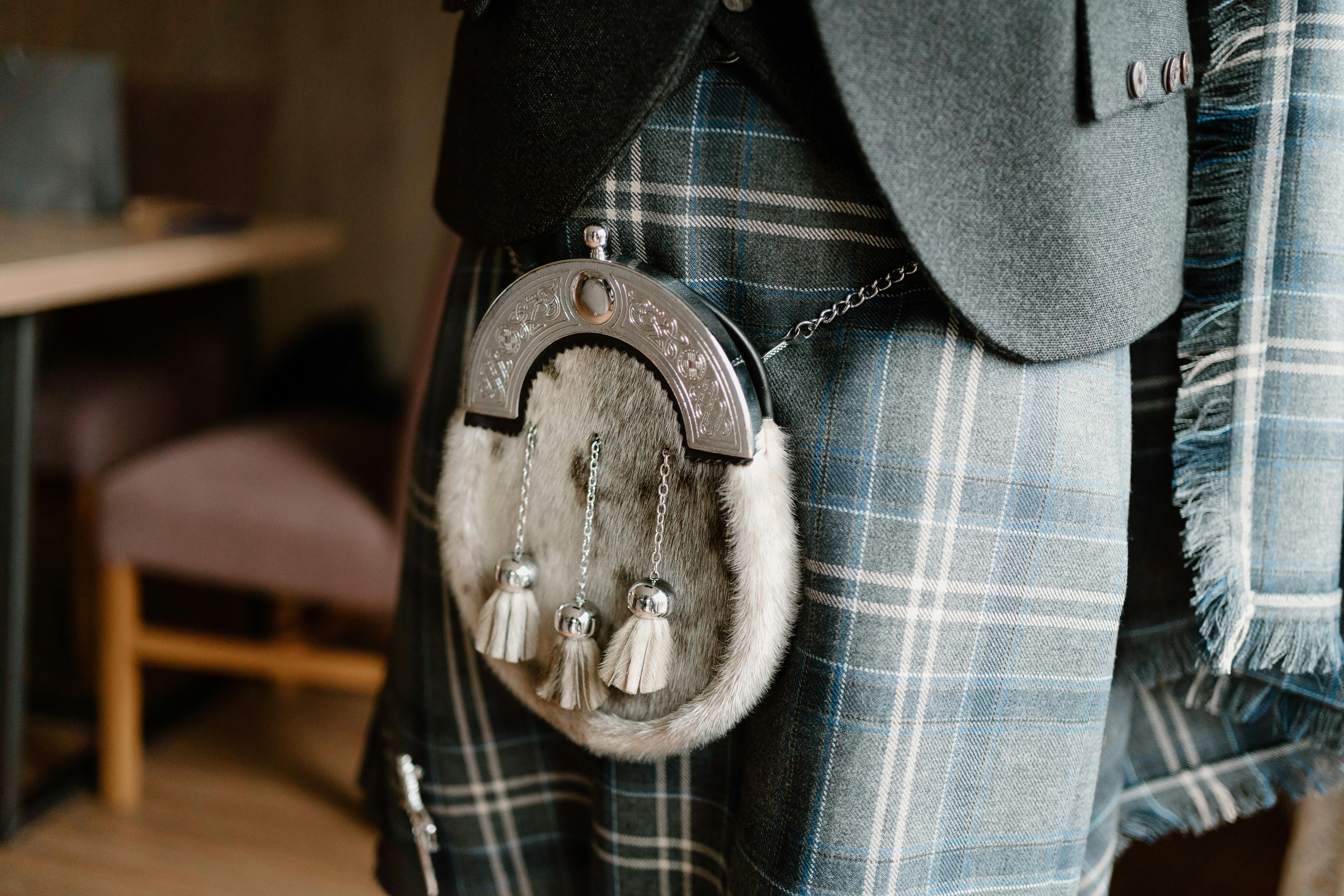
Kilts are synonymous with Scotland. Or, perhaps, Scotland is synonymous with kilts.
What was historically the garment of peasants has evolved far beyond that, as a political rallying cry, traditional formalwear, and gender rebel fashion.
Evolving the Kilt from Practical Dress to Cultural Signifier
Kilts have likely been worn since the Sixteenth, or even Fourteenth, Century, in Scotland, always by men.
In 1707, Scotland signed the Act of Union. However, a schism developed between the Scottish Jacobites, people who believed King James II of England and VII of Scotland was the rightful monarch and often of lower classes in the Highlands, and those loyal to England, the wealthier Lowlanders. The divide came to a head at the Battle of Culloden in 1746.
In order to squash the Jacobite Rebellion, the British needed to erase Scottishness as a cultural identity with Highland dress, kilts, and any plaid garments, being the most distinct cultural signifiers. The British framed this as an attempt to “rid them of their assumed backwardness and barbarity at a time when the rest of Britain was thriving economically.”
By creating a series of binary differences between the British and the Scottish (specifically the Highlanders) – proper versus barbaric, wealthy versus poor – some Scottish individuals would begin to assimilate with the British and discredit the Highlanders, who made up the majority of the Jacobites.
Gender and sexual non-conformity were other binaries the British employed to differentiate between the Scottish Highlanders and British. Propaganda would describe the kilt as being unhygienic and indecent, as it was assumed men did not wear undergarments beneath their kilts. Messaging highlighted both the feminine nature of kilts, simultaneously emasculating the men who donned them and posing them as sexual barbarians, not unlike how transgender individuals, primarily transgender women, are portrayed by conservative media today.
In this way, any Scottish person wearing a kilt became a political act of resistance against imperialist Britain, a notion that would be echoed two centuries later by punk and other counter-cultures.
Co-Opting the Kilt for British Assimilation
A series of events unfolded that catapulted Highland Dress into popularity. In 1782, the law was overturned by King George III. After the “Young Pretender” Charles Stuart died in 1789, the soon-to-be King George IV became fascinated with Scotland, as did his daughter, Queen Victoria. Further, the Highland Regiment, who wore Highland Dress, became heroes of the Napoleonic Wars (1803-1815). Proponents of Scottish and English solidarity, such as Sir Walter Scott, saw the kilt as a symbolic way to bring the two countries together, united as “British.”
Notably, the kilt, traditionally worn by men in the Highlands, became ubiquitous among all genders and British geographies. What was once a utilitarian garment of Scottish peasantry had been co-opted by the ruling, colonizing class as fashion.
Reclaiming the Kilt for Rebels & Outcasts
Into the 1900s, Highland Dress continued to be associated with the military and adopted in ceremonial dress by Scottish and English people alike. However, as counter-culture movements caught on in the 1970s, the kilt was reclaimed by punks as a symbol against the oppressive British government and mainstream society. Subsequently, kilt and tartan made its way onto high-fashion runways among designers reflecting punk culture and rebellious nature of Scotland.
As Scotland and England were unified under one throne, preserving Scottish identity, distinct from England and Great Britan at large, became important for many. Embodying centuries of history, the kilt remains a statement against tyranny and conformity, and ubiquitous symbol of autonomy and individuality.
Want to learn more about kilts? Download the full article!


BIBLIOGRAPHY:
Anderson, Grant. “Non-Conforming Gender Geographies: A Longitudinal Account of Gender Queerness in Scotland,” PhD thesis, University of Glasgow, 2019. https://theses.gla.ac.uk/72469/.
Bolton, Andrew. “The Kilt.” The Metropolitan Museum of Art, October 1, 2004. https://www.metmuseum.org/essays/the-kilt.
Cheape, Hugh. “Gheibhte Breacain Charnaid (‘Scarlet Tartans Would Be Got…’): The Re-Invention of Tradition.” Essay. In From Tartan to Tartanry: Scottish Culture, History and Myth, edited by Ian Brown, 13–31. Edinburgh: Edinburgh University Press, 2012.
“History of the Black Watch.” The Black Watch Castle and Museum. https://theblackwatch.co.uk/history/
“The History of Scotland.” National Trust for Scotland. Accessed September 19, 2025. https://www.nts.org.uk/learning/adult-learning/the-history-of-scotland.
Loranger, David P. “Scottish Kiltmaking: Knowledge, Practice, and Potential for Protected Geographic Indication.” PhD diss., Iowa State University, 2016. https://dr.lib.iastate.edu/etd/15964.
Newsome, Matthew. “The Early History of the Kilt.” The Scottish Tartans Museum and Heritage Center,” 2003. https://scottishtartansmuseum.org/education/early-kilt/
Newton, Michael. “Paying for the Plaid: Scottish Gaelic Identity Politics in Nineteenth-Century North America.” In From Tartan to Tartanry: Scottish Culture, History and Myth, edited by Ian Brown, 63-81. Edinburgh University Press, 2012.
Royale, Trevor. “From David Stewart to Andy Stewart: the Invention and Re-Invention of the Scottish Soldier.” In From Tartan to Tartanry: Scottish Culture, History and Myth, edited by Ian Brown, 48-62. Edinburgh University Press, 2012).