
Throughout United States history, immigrants from Asia and Pacific Islands have made significant contributions to the country, while also facing systemic and interpersonal discrimination. In particular, Asian women experience fetishization, while Asian men experience emasculation or are perceived as asexual, making conversations surrounding gender identity and sexual orientation particularly fraught within the community.
To challenge these stereotypes and respect the diversity of the Asian American, Native Hawaiian, and Pacific Islander community, we are uplifting the queer stories of AANHPI individuals to bring awareness to the intersectionality of race, gender identity, and sexual orientation today and throughout history.
In the second half of AANHPI Month, we celebrate LGBTQIA+ icons Noguchi Yonejirō, Tamara Ching, and Michiyo Fukaya.
Noguchi Yonejirō “Yone” (1875–1947)
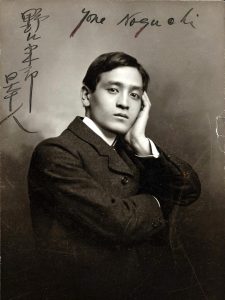 Noguchi Yonejirō “Yone” was from heimin, from a middle-class background, growing up in a small town near Nagoya. A curious youth, he was eager to learn and enrolled in a school in Tokyo that specialized in Western language and culture.
He emigrated to San Francisco in 1893 at the age of eighteen to continue his studies. Like other youth Japanese men of the time, he arrived in America intending to work in a wealthy home in exchange for free room and bod while attending classes.
Yone experienced the challenges of being Japanese in America upon arrival. As he was walking the street, “I was suddenly struck by a hard hand from behind and found a large, red-faced fellow, somewhat smiling in scorn.” The man threw a slur at Yone and spat in his face. Working in San Francisco also proved challenging as, though he had studied English for several years, he had not learned the proper pronunciation.
Four year after arriving in California, Yone was able to move to “The Hights,” a colony of writers and artists founded by essayist, Joaquin Miller. Now connected to a rich network of creatives through Joaquin, Yone began sharing his poetry. Gelett Burgess and Porter Garnett, the editors of The Lark, San Francisco’s leading literary journal, were interested in his work. They helped Yone refine his poems and English proficiency, without eliminating the Japanese roots of his work. By 1900, Yone began to gain notoriety as an emerging talent in poetry and fiction, making ripples nationwide. Over the coming years, he would relocate to New York, England, and Los Angeles in hopes of growing his reputation.
His first English-language novel, The American Diary of a Japanese Girl, is a humorous, first-person (possibly semi-autobiographical) account of a young girl’s travels through American. Later, its sequel The American Letters of a Japanese Parlor-Maid, grapple with the challenges of the immigrant experience. Scholars have pointed to Yone’s selection of a female narrator depicting heterosexual romance as a way for Yone to express and explore his own achilean identity. The book also has explicitly sapphic moments of affection as well. Further, gender politics are a central part of the novels, including instances of cross-dressing, potentially standing in for Yone’s feeling constrained by gendered expectations of marriage.
Yone’s correspondence with Charles “Charley” Warren Stoddard began with a brief letter of introduction in 1897. Charley, an established author and traveler, had been quite taken with magazine articles about Yone. Charlie, who was achillean, asked for a photograph of Yone for his study and wrote passionately about his desire for Yone. Yone expressed “great pleasure” in receiving these letters. The exchange continued, each deeply enamored with the other from afar and finding tremendous comfort in each other’s words.
Yone and Charley finally met in 1900. Yone wrote of the visit, “Why shortest—how sad it was short!—, but loveliest visit to you was my dream realized, it cannot be forgotten. It was a great event in my life. . . . You are my ideal person.”
Charley certainly fetishized Yone as an exotic stereotype. By Yone’s own assessment, Charlie seemed to be disappointed that Yone had adopted an American sense of dress and demeanor. Throughout his travels, Charley’s appreciation for Asian men had as much to do with being genuinely sexually and romantically attracted to them as it did with an imperialist agenda. Similarly, it is entirely possible that Yone saw Charley as an artistic mentor and that was the source his affection, including physical relationship.
Charley would not the be only love of Yone’s life. In 1900, Charley introduced Yone to Ethel Armes, a journalist from a prominent southern family. Yone was taken with Ethel, a great beauty and a great mind, and her became intent on marrying her. However, at the same time, he was living with his editorial assistant, Léonie Gilmour.
When Léonie became pregnant with Yone’s child, she separated from him and moved to Los Angeles. Even though she knew nothing about Ethel, she was fed up with him. Yone would only learn about the birth of his son, Isamu, through an article in the Los Angeles Herald.
Yone’s relationship with Ethel was, like with Charlie, strained by racial stereotypes. In correspondence with her friend (and love interest), Alice Wiggins, Ethel wrote, “he is not big as I dream nor strong nor bravehearted nor practical… He is nearly all that my heart desires—but is not all because he is not what I think men ought to be.” Her letters echo how Asian men were emasculated at the time and continue to be today. Nonetheless, Ethel agreed to marry Yone, despite continuously declaring she wanted to marry a woman and could not see herself in a straight marriage for more than a year. Unfortunately, when Ethel learned about Léonie and Yone’s baby, she broke off the engagement.
In 1904, Yone would relocate to Japan and marry his Japanese housekeeper, Matsuko Takeda. They had three children together.
Léonie would eventually move to Japan in 1907, likely to protect her young, born-out-of-wedlock son, Isamu, from growing anti-Japanese sentiment. Yone would attempt to provide for Léonie and Isamu, but the relationship was strained. Léonie would stay in Japan to raise her son independent for seventeen years. Isamu would become a renowned sculptor and architect.
Yone was appointed chair of the English Literature Department at Keio University. He would continue to have some recognition for his writing, but her felt that he was always caught between two worlds: his poetry was too Western for Japanese audiences; yet poorly received by English-speaking audiences, both in the United State and England. His poetry would become less personal and artistic, and more aligned with national causes as Japan entered World War II.
Later in life, Yone denounced homosexuality and there is no evidence Yone ever had affection for another man again. It is possible this was due to Japanese society’s shifting tolerance of same-gender affections. However, he maintained correspondence with Charley, even requesting that the ageing author move to Japan so he could be cared for. In 1914, he wrote a stirring tribute to Charley as the epilogue to his own memoir. “whose memory I cherish in my inner heart.”
Yone’s home was destroyed in the 1945 US bombing of Tokyo. He passed away from stomach cancer in 1947.
In the 1950s, Yone’s son Isamu installed a sculpture garden at Keio University, which served as a “reconciliation of wounds,” both that between Japan and the United States in the post-war era and of estranged father and son.
Sources
Alston, Evan Connor. “Yone Noguchi and Miss Morning Glory: American Humor, Identity, and Cultural Criticism in the Works of Yone Noguchi.” Masters Theses & Specialist Projects. Western Kentucky University, 2020. https://digitalcommons.wku.edu/cgi/viewcontent.cgi?article=4222&context=theses.
Benemann, William. “Butterflies Caught in a Web.” The Gay & Lesbian Review (Boston, MA), April 2024. https://glreview.org/article/butterflies-caught-in-a-web/.
Inaga, Shigemi. “What the Son Inherited from His Father? Preceded by A Brief Introduction to the Noguchi Legacy as a Working Hypothesis.” International Research Center for Japanese Studies (of issue: March 2011 Kyoto, Japan), March 20111.
Marx, Edward. “A Ghost from the Abyss: Yone Noguchi’s Poetry in Japanese.” The Transactions of the Asiatic Society of Japan, 2018.
Nawrocki, Jim. “A Writer of Opportunity.” The Gay & Lesbian Review, no. January-Feburary 2013 (February 2013). https://glreview.org/article/a-writer-of-opportunity/.
Noguchi, Yone. The Story of Yone Noguchi, Told by Himself. George W. Jacobs & Company, 1914.
Sueyoshi, Any. “Intimate Inequalities: Interracial Affection and Same-Sex Love in the ‘Heterosexual’ Life of Yone Noguchi, 1897–1909.” Journal of American Ethnic History 29, no. 4 (2010): 22–44.
Zhang, Lisa Yin. “The Incomplete Chronicle of Léonie Gilmour.” The Noguchi Museum, n.d. Accessed April 6, 2026. https://www.noguchi.org/isamu-noguchi/digital-features/the-incomplete-chronicle-of-leonie-gilmour/.
Photo Credit: Yone Noguchi in 1903. Smithsonian Institution.
Tamara Ching (born 1949)
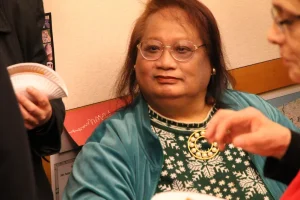 As an Asian American transgender woman in the 1960s, or “Queen” as she calls herself,* Tamara Ching was navigating San Francisco in the aftermath of the Compton’s Cafeteria Riot. While the Stonewall Riots are the most famous uprising against anti-LGBTQIA+ laws, tensions were rising across the country. In 1966, the police raided Compton’s Cafeteria, a late-night hot spot for the queer community to gather, which catalyzed the queer community into organizing.
Tamara spent her entire life in San Francisco, spending her formative years in Chinatown. As the second child, her traditional Chinese mother did not impose many expectations on her. As a result, Tamara describes growing up in “an androgynous world,” where her parents were indifferent to her affinity for dolls and other feminine toys. However, she recognized that this was different than other children. In addition, conversations about sex were nonexistent in her community.
Growing up was not easy for Tamara. However, if was her race that made her standout, not her gender. She was bullied, often with her older brother instigating the terror. In middle school, she began to fight back for survival.
As a young queer person, she gravitated to the Tenderloin’s active LGBTQIA+ community, one of the only places queens could live openly. The Tenderloin was at both times a safe haven for people who had been shunned by their family and communities, but also an impoverished neighborhood and red light district. Her mother was not present and she was free to roam the streets.
Like many young transgender people, Tamara turned to sex work as a teenager. Reflecting on the experience in her 50s, Tamara explains that this was survival for many, but also a way to tolerate transphobia on a daily basis and form bonds with other Queens. Tamara started living publicly as a woman in the late 1960s. She selected the name “Tamara” to pay homage to her Polynesian heritage and “Ching” to reclaim being bullied as a child for being Chinese.
Though Tamara was not present on the night of the Compton’s Cafeteria raid (in fact, a policeman had told here there was going to be a riot), she was a regular there and galvanized by her community’s response to oppression.
“Compton’s nourished people. People would sit there for days drinking a cup of coffee,” she shared. “It was good to go and be seen and talk to people about what happened during the night.
In retrospect, the Compton’s Cafeteria Riot is an important moment in the LGBTQIA+ movement. However, for Tamara and other Queens, it was just another night. Things returned to normal, especially for transgender and non-white people who were seldom included in LGBTQIA+ organizing at the time.
Her focused was on helping younger sex workers navigate the community safely. She moved throughout the country, rose the ranks in the Social Security Administration, and continued sex work throughout the 1970s and 1980s.
During the AIDS Epidemic, as she lost dozens of friends and loved ones, Tamara played in active role in ensuring that transgender sex workers were supported. In fact, she received one of the only grants from the Centers for Disease Control and Prevention to serve this population. She also worked with Grandmothers Against Poverty and AIDS to start the first transgender support program in the country. Further, with her lived experience as a sex worker, Tamara would conduct outreach and education about HIV prevention in bars that trans sex workers frequented. She focused on empowering individuals to become peer educators and share the importance of safe sex with others in the community. She also focused on outreach into queer and straight Asian communities, understand that conversations about sex were culturally taboo.
In the 1990s, ten years into the AIDS Epidemic, the community began to recognize Tamara’s impact in supporting an otherwise neglected community. She was voted as the city’s Honorary Pride Parade Marshal in 1999. As transgender people began to gain visibility in the community, she gave testimony to the San Francisco Human Rights Commission to ensure transgender and bisexual people were included in the city’s anti-discrimination ordinance, which was finally adopted on January 1, 1995.
In 2005, Tamara said down with historian Susan Stryker to share her experience of growing up trans in 1960s San Francisco in Screaming Queens. She shared the realities of police harassment, the intersection of race and gender, being trans in the 1960s, and finding community among other Queens.
To recognize her contributions to the community, Tamara was depicted along other transgender activists in a mural on Clarion Alley in San Francisco. Some of her papers are preserved at the GLBT Historical Society in San Francisco.
Sources
Ching, Tamara. “Tamara Ching : The Stanford Pride Oral History Project.” (Stanford (Calif.)), Stanford Historical Society, August 5, 2018. Audio. Stanford University. Libraries. Department of Special Collections and University Archives. https://purl.stanford.edu/mg511nn6366.
Pasulka, Nicole. “Ladies In The Streets: Before Stonewall, Transgender Uprising Changed Lives.” Code Switch. NPR, May 5, 2015. https://www.npr.org/sections/codeswitch/2015/05/05/404459634/ladies-in-the-streets-before-stonewall-transgender-uprising-changed-lives.
Stryker, Susan. Tamara Ching Interview. 2001. GLBT Historical Society,. https://glbt.i8.dgicloud.com/node/25627.
Photo Credit: Tamara Ching, Unknown.
Michiyo Fukaya (1953-1987)
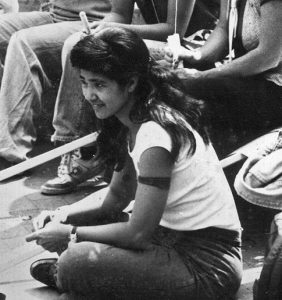 Michiyo Fukaya was a biracial poet and writer. Though her work isn’t well known, it documents the unique experience of being a biracial Asian American lesbian. Her body of work demonstrates the “importance of deploying negative affect, such as stigma, shame, pain and anger, as productive forms of political transformation.” In many ways, her work serves as a mirror for others to recognize and validate their experiences. A mirror which Michiyo herself seldom benefited from.
Michiyo, born Maragret Cornell, was born to a Japanese mother and white American father who was stationed in Japan. Her mother’s family had been significantly impacted by the Great Depression and World War II, which resulted in the family business downsizing and eventually being bombed out. As a young mother to two biracial children, Michiyo and her older borther, marrying Michiyo’s father was an act of survival.
When Michiyo was three, her family moved from Japan to Burlington, Vermont. Growing up was challenging, beginning with her mother’s death from cancer in 1958, possibly a result of being present during the atomic bombs. Michiyo was left with her emotionally and sexually abusive alcoholic father. Her stepmother, who was also physically abusive, forbade her from mentioning her mother. In addition, she was relentless harassed for being part-Japanese and poor by her classmates, teachers, and relatives on her father’s side.
“My father’s family was a hindrance in the process of growing up,” Michiyo wrote. “They loved me in their fashion, but I was pressed to call myself White. At the same time, the relatives referred to my brother, sisters and me as the ‘Japanese kids’…This gave me the feeling that I should be ashamed of my Japanese blood. Somehow, it was unacceptable to be what I was.”
With her mother gone, she was completely cut off from her Japanese identity. To overcome this, she explains, “Pride and silence were the main weapons I had.”
Michiyo attended college at the University of Massachusetts, Amherst. There, she began to build connections with other Asian Americans, as well as strengthen her writing. However, she was continuously in a space of feeling “noting Asian enough” or “not white enough,” a feeling many multi-racial people experience.
Sometime in the late 1970s, Michiyo discarded her birth name “Margaret” and, years later, last name “Cornell.” Her chosen name, “Michiyo Fukaya,” reclaimed her Japanese heritage and adopted her mother maiden name in lieu of her father’s last name.
After graduation in 1975, Michiyo struggled. She found refuge at the Elizabeth Lund Home, a homeless shelter, where she gave birth to her daughter, Mayumi. Within a year of the birth, Michiyo voluntarily sought treatment at a mental health facility in Vermont. Where she was diagnosed with schizophrenia. After being discharged, she recognized her lesbian identity and settled into an affirming “women’s community” in Vermont and began working at a shelter for women escaping domestic violence.
Mayumi would be raised by neighbors from the community, while Michiyo sought mental health, housing, and financial stability. However, she tried to remain present, visiting her daughter often.
Lynn Vera, a member of the women’s community, reflected, “[Michiyo] was torn up from the conflict of knowing she could handle her life when her daughter was cared for by others, but then she was overcome by feelings and fears of abandoning her bi-racial daughter to white women, and that she would have no support/income if she wasn’t living with Mayumi.” When Mayumi was four, Michiyo would ask Lynn to become her daughter’s guardian if anything should ever happen.
She used her writing as an outlet to make sense of her experience and bring them to light for others, including themes of rape, sexual violence, and the erasure of queer people of color. Her writing captures honest vulnerability about her struggles with narrative arcs that promise strength and confidence in overcoming challenges. They are just as much personal as they are an extension of her political activism.
She frequently performed at open mics, spoke at rallies, and was active in writing groups, while balancing various jobs in hospitality and social services. One of her lovers, Myra Lilliana Splitrock, reflected, “Her poetry readings were special because of her sensibility, sensitivity and dignity.”
In 1979, Michiyo attended the First National Third World Lesbian and Gay Conference in Washington, DC, which the first international group for LGBTQIA+ Asians was formed. At the conference, she made a prolific speech, “Living in Asian America,” pointing out racism in the gay liberation movement and the importance of uplifting intersectional experience. It is one of the first public broadcasts of a lesbian Asian American. Michiyo was also active in movements for a women’s right to choose, and bringing awareness to survivor of sexual assault.
Michiyo self-published a chapbook, Lesbian Lyrics, in 1981. This collection is romantic and erotic, as much as it is about self-love and discovery.
She writes in the poem “MOTHER”:
A teenage girl asked me
Why I became a lesbian;
I said I fell in love
With a woman
And that woman
Is myself, mother, mostly myself.
Michiyo was deeply invested in community. Despite her limited income, she made modest donations grassroots efforts support Asian writers, environmental, and Native American communities.
She helped advocated to the City of Burlington, Vermont approve state’s first pride celebration in 1983. She was focused on helping other Vermonters seen lesbian and bisexual women as community members no different from other neighbors. In 1985, on Vermont Public Radio, she shared her experience as a single mother and invited other Vermonters to support the pride festivities. Neighbors, friends, and lovers recall Michiyo’s contagious joy just as frequently as they document her struggles.
While Michiyo found threads of community in Vermont, she continued to experience nervous breakdowns stemming from her experience as an Asian American lesbian single mother in a predominantly white environment.
“I am a woman, a lesbian, an Asian American,” she wrote in her essay, ISOLATION, “and I feel my life is being drained away by my struggles, but I am still trying.”
Michiyo Fukaya died by suicide on July 9, 1987. In 1996, he anthology, A Fire Is Burning It Is In Me was published, a posthumous collection of her poetry, speeches, essays, letters, and articles, edited by an activist colleague, Gwen Shervington. Her ashes are buried at HOWL, a land trust stewarded by “the full diversity of women” and gender expansive folx in Huntington, Vermont.
Sources
Chen Weinstein, Lean. “Songs of Resistance: Transformations of Trauma in the Writing of Michiyo Fukaya.” San Francisco State University, 2016. https://scholarworks.calstate.edu/downloads/4t64gq04t.
Shervington, Gwendolyn L., ed. “GROWING UP EURASIAN IN VERMONT.” In A Fire Is Burning It Is In Me: The Life and Works of Michiyo Fukaya. New Victoria Publishers, 1996. https://archive.org/details/fireisburningiti0000unse.
Shervington, Gwendolyn L., ed. “ISOLATION.” In A Fire Is Burning It Is In Me: The Life and Works of Michiyo Fukaya. New Victoria Publishers, 1996.
Vermont Folklife. “Making Pride.” Accessed April 5, 2026. https://www.vtfolklife.org/pride-making.
Wallace, Nina. “5 Queer Nikkei Ancestors Everyone Should Know About.” Densho: Japanese American Incarceration and Japanese Internment, June 17, 2020. https://densho.org/catalyst/5-queer-nikkei-ancestors-everyone-should-know-about/.
Photo Credit: Michiyo Fukaya attending the first lesbian gay pride parade and celebration, City Hall Park, Burlington, June 1983; photo by Lynn Vera

Why is AANHPI Heritage Month in May?
Asian American, Native Hawaiian, and Pacific Islander Heritage Month has been recognized in May across the United States since the 1970s, commemorating the arrival of first known Asian American immigrant from Japan, Nakahama Manjirō, on May 7, 1843 and the completion of the transcontinental railroad on May 10, 1896, a feat made possible by a considerable number of Chinese immigrants.
Why are these communities recognized together?
While the category “Asian American, Native Hawaiian, and Pacific Islander” (AANHPI) was established in the 1960s to cultivate political power, it is important to recognize that the community is not a monolith and an umbrella term not embraced by all. Asian, Native Hawaiian, and Pacific Island Americans represent people from a massive geographic region with diverse cultures and histories. This community includes 19 million Americans, 59% who are first-generation immigrants.
How does queerness and AANHPI identity intersect?
Throughout United States history, immigrants from Asia and Pacific Islands have made significant contributions to the country, while also facing systemic and interpersonal discrimination. In particular, Asian women experience fetishization, while Asian men experience emasculation or are perceived as asexual, making conversations surrounding gender identity and sexual orientation particularly fraught within the community.
A Note on Language
Our understanding of gender identity and sexual orientation has evolved over time. Some of the words we use today, like lesbian, transgender, or nonbinary, were not popular – or even existed – in certain periods of history.
Historians and researchers have different perspectives about how to explain sexual orientation and gender identity of people in history and what language is used. In my work, I have adopted the following guidelines, which is in no way definitive.
Sexual Orientation
I have elected to use the term “sapphic” to describe people who were perceived as women throughout the majority of their lives and had emotional and/or physical romantic relationships with other people who identified as women throughout a majority of their lives. This includes people who we may today understand as nonbinary or transmasculine, but identified or were perceived as women in their time.
Similarly, the term “achilean” is used to describe people who were perceived as men throughout the majority of their lives and had emotional and/or physical romantic relationships with other people who identified as men.
The term “bisexual” is used to describe people who had romantic and physical relationships with people of all genders throughout their lives. While today many people employ “bisxeual” as an identity, I use it as a way to describe behavior and experience in the past. For many, their sapphic or achilean experiences and sexual fluidity may not have been a central part of their identity due to societal and cultural norms of the time.
Gender Identity
Regarding people who may have been nonbinary or transgender in the contemporary understanding of gender identity, I use the word “gender non-confirming.” This includes people who were known to “cross dress” by wearing clothing considered appropriate for a gender other than that which they were assigned at birth. In some cases, these individuals were doing this to express their nonbinary or transgender gender identity, but may not always have been the case.
I have elected to use the adjectives “transmasculine” and “transfeminine” to describe the experience of someone who has considerable primary source evidence that someone lived as or felt they were a gender different from that which they were assigned at birth. Because the term “transgender” and the concept of transitioning in all aspects of life is modern, I have elected not to use that term.
In some contemporary settings, transgender women would use colloquial, non-academic/medical terms like “Queen,” to describe themselves. These terms are used interchangeably with modern terms in those respective profiles.
Learn About Other Queer Icons
Worcester & HIV Care | Queer Worcester Icons 2026
In the early 1980s, patients, predominantly young gay men, began arriving in hospitals with a...
Frances Perkins | Queer Worcester Icons 2026
Originally published for Women’s History Month 2025 The workers’ rights we benefit from today are...
Elizabeth Bishop | Queer Worcester Icons 2026
While she avoided the public spotlight, Elizabeth Bishop’s lasting legacy places her among one of...