
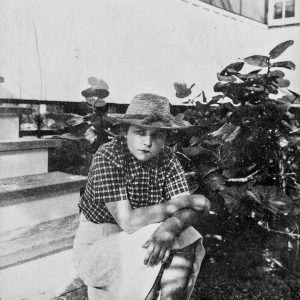
 While she avoided the public spotlight, Elizabeth Bishop’s lasting legacy places her among one of the “one of the most important American poets” of the 20th century.
Elizabeth was from a wealthy family. Her father William Bishop, an American with Canadian ancestry, was a successful builder from Massachusetts and her mother, Gertrude née Boomer, was from Nova Scotia. When Elizabeth was just eight months old, William passed away from Bright’s Disease. Gertrude was distraught. The grief and resulting loss of U.S. citizenship was straining. Ultimately, Gertrude would be institutionalized at Dartmouth Sanatorium, Nova Scotia, in 1916. Elizabeth would never see her mother again, a loss that would influence her work considerably, even if she did not acknowledge that until her forties.
Initially, Elizabeth Bishop was raised by her maternal grandparents in Nova Scotia and later paternal grandparents in Worcester. She suffered from chronic illness throughout her childhood that are believed to have been psychosomatic, resulting from the trauma of losing her parents and emotionally distant grandparents. Fortunately, her Aunt Maude and Aunt Grace became more involved in her life, which provided more meaningful connections and a sense of belonging.
As early as age eight, Elizabeth demonstrated a passion for poetry, supported by her Aunt Maud’s extensive library and premier education at Walnut Hills School for Girls. She excelled in English and Latin with writing skills far-surpassing her peers. While overall her physical and emotional wellbeing improved while she lived with her aunts, she was sexually abused by her uncle, an account she never shared other than with her psychiatrist.
Elizabeth’s economic privilege and academic prowess afforded her the opportunity to study at Vassar College. At Vassar, Bishop founded a literary journal Con Spirito with Eleanor Clark, Margaret Miller, and Mary McCarthy when the college’s traditional literary journal would not accept her poems. She also met her lifelong mentor poet Marianne Moore. Marianne introduced Elizabeth to a modern, occasionally radical, approach to poetry.
While Elizabeth was creatively motivated with the support of her mentor, her alcoholism began in fervor. Elizabeth’s mother died in the institution she had lived in for nearly twenty years. The grief, combined with a fear that the mental illness may be hereditary, led to potent depressive episodes which alcohol would numb.
After graduation in 1934 with a degree in English Literature, Elizabeth relocated to New York to become a writer. Facilitated by her inheritance, Elizabeth spent many years travelling throughout Europe and Northern Africa. The poems resulting from these adventures demonstrate her attention to detail about the physical world, which evoke subtle emotion without being explicitly personal to Elizabeth’s experience. In many ways, travelling kept Elizabeth active, distracting her from the fact that she did not have a true family and home to return to.
In 1936, Elizabeth moved to Key West, Florida with college friend Louise Crane, after visiting the area for a two-month fishing trip. However, by Summer 1939, Elizabeth moved back to New York. While the exact reasons are unknown, she simply would refer to this time as “troubles in New York.” Many assume that the move back to New York was likely due to mental distress and relationship conflicts with Louise.
Despite these struggles, Elizabeth published her most anthologized poem ‘The Fish’ in the Partisan Review in March 1940. The poem captures the experience of catching a Caribbean jewfish, while reflecting on mortality. She also published her first collection of poems in 1946 in the volume North and South.
In 1947, Elizabeth met Robert Lowell, an author who had won a Pulitzer Prize (over her own anthology). Robert was well-established and charismatic, which helped the perpetually shy Elizabeth get connected to the literary world. At times, their friendship was flirtatious, which Elizabeth encouraged.
During this period, Elizabeth began to gain national recognition. She was named the 1949-1950 Consultant in Poetry to the Library of Congress (now the Poet Laureate). In 1955, her second collection, North & South – A Cold Spring, earned her a Pulitzer Prize the following year. However, she always felt unworthy and lonely, as well as suffered from psychosomatic illness. While friends tried to get her professional support, Elizabeth always failed to follow through.
In 1942, Elizabeth had met Maria Carlota de Macedo Soares, known as Lota. Lota was a Brazilian landscape architect and daughter of a newspaper magnate. Around 1951, Lota and her partner, Mary Morse, invited Elizabeth to visit them in Brazil as part of her continued global escapades. Lota and Elizabeth would fall in love. For the first time in her life, Elizabeth felt valued and supported, describing the next decade of her life as the happiest. In fact, with that sense of safety, Elizabeth began to examine her childhood trauma through her poetry. She moved to Brazil, where she would stay until 1967.
Like Elizabeth, Lota was deeply committed to her work. However, this work often took her away from Elizabeth for weeks, resulting in significant exhaustion. Further, During these times, Elizabeth’s loneliness would turn into depression and alcoholism. Elizabeth took a teaching job in Seattle for a short-time and began an affair, which Lota would discover through letters from Elizabeth’s lover. Lota was hysterical with jealousy and depression after losing her job due to political shifts. Both Lota and Elizabeth were hospitalized to support their wellbeing, but did little to mend their partnership.
This mutual destruction reached a pinnacle in Summer 1967. Elizabeth flew to New York with the intention of Lota joining her when her doctors permitted it. However, Lota was distraught and insisted on coming to New York immediately. On September 19, 1967, Lota arrived. However, that night she overdosed on tranquilizers. This loss, matched with guilt over not attending the funeral at her doctors’ advice, had a life long impact.
Elizabeth moved in with Rozanne Cumming, her lover from Seattle, but the relationship only lasted two years as she was distraught by the reminder of Lota and how their relationship ended.
In 1970, with Robert Lowell’s influence, Elizabeth began teaching at Harvard University, making her the first woman to teach an advanced writing course there. She began a relationship with Alice Methfessel. What began as a friendship between a new professor and young administrative assistant grew into a partnership, part-romantic, part-time caretaker, as Elizabeth’s various ailments were exacerbated with age, alcohol, and smoking. Their relationship blossomed over the next five years. Despite attempting to be discreet, it was well-known among students and faculty that they were partners.
Elizabeth, once again, felt supported and energized by her young partner’s love and vivaciousness. However, their romance ended when Alice fell in love with a man named, Peter. Elizabeth was distraught, ran away to Florida, and survived a suicide attempt. The ordeal resulted in her most famous poem, “One Art.”
Alice would come back to Elizabeth and care for her for the next eighteen months until Elizabeth passed away from a brain aneurysm. Alice was named as her next-of-kin, ensuring that Elizabeth’s literary legacy was preserved.
After her death, her impact on poetry became increasingly apparent across genres, especially from a technical standpoint. Across her body of work, she blends present observation with memories of the past with specificity. As a meticulous poet, she would continuously revise her work before allowing them to be published, ultimately only sharing around 100 poems during her lifetime.
Sources
Academy of American Poets. “Elizabeth Bishop.” Accessed June 28, 2026. https://poets.org/poet/elizabeth-bishop.
Buller, Norman. “Elizabeth Bishop: Art From Life and Life Itself.” The London Magazine, February 8, 2016. https://thelondonmagazine.org/article/elizabeth-bishop-art-from-life-and-life-itself/.
Claremont Review of Books. “My Breakfast with Elizabeth Bishop.” Claremont Review of Books, March 6, 2017. https://claremontreviewofbooks.com/digital/my-breakfast-with-elizabeth-bishop/.
Roth Pierpont, Claudia. “Elizabeth Bishop’s Art of Losing.” The New Yorker, February 26, 2017. https://www.newyorker.com/magazine/2017/03/06/elizabeth-bishops-art-of-losing.
The Poetry Foundation. “Elizabeth Bishop.” Accessed June 28, 2026. https://www.poetryfoundation.org/poets/elizabeth-bishop.
Photo Credit
Photograph courtesy Yale Collection of American Literature / Beinecke Rare Book and Manuscript Library

Learn About Other Queer Icons
Worcester & HIV Care | Queer Worcester Icons 2026
In the early 1980s, patients, predominantly young gay men, began arriving in hospitals with a...
Frances Perkins | Queer Worcester Icons 2026
Originally published for Women’s History Month 2025 The workers’ rights we benefit from today are...

John O’Reilly & James Tellin | Queer Worcester Icons 2026
For 60 years collage artist, John O’Reilly (1930-2021) and sculptor James “Jim” Tellin (1930 -...