
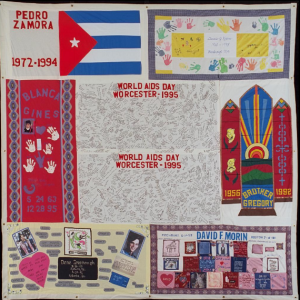
 In the early 1980s, patients, predominantly young gay men, began arriving in hospitals with a mysterious autoimmune disease. As researchers analyzed these patients’ symptoms, the source was identified as Human Human Immunodeficiency Virus (HIV), which would wreak havoc on the body when untreated and develop into Acquired Immune Deficiency Syndrome (AIDS). With the U.S. government slow to even acknowledge the AIDS Crisis, scientists, medical providers, and individuals came together to push forward research and care for people living with HIV.
While the AIDS Crisis made headlines in large cities like New York City, smaller cities like Worcester were not spared. With little government or funding infrastructure, resources for HIV care and research were scarce. Worcester stood out through the Worcester AIDS Coalition, founded in 1987, which brought together the city’s health department, school department, drug treatment facilities, community health centers, hospitals, correctional facilities, and other health and social services organizations. Locally, HIV was mainly spread between people who used intravenous drug use or sexual contact with those individuals. Because of the stigma already imposed on this population, the Coalition’s response was integral in ensuring they received the attention and care they deserved. From this coordinated community response, new organizations were founded to prioritize caring for people living with HIV, including AIDS Project Worcester, which remains a tentpole of health equity in Worcester and is one of the country’s longest serving HIV care organizations.
Worcester’s community response was bolstered by University of Massachusetts Chan Medical School (UMass) role at the forefront of HIV clinical research and care. In the early years of the AIDS crisis, viral immunologist John L. Sullivan, MD began researching the HIV virus at the molecular level, providing critical insight into how HIV impacts the immune system. Dr. Sullivan received a grant from the National Institute of Health to study the condition, which has put UMass at the forefront of HIV/AIDS research for over 40 years.
Dr. Sullivan’s research group was one of the region’s first to offer anonymous HIV testing. As many researchers were doctors as well as scientists, much of the work focused on patient care and education alongside innovation in medicine. In 1988, UMass became one of the first four AIDS Education and Training Center in the country. With stigma radiating in society, even among healthcare professionals, these centers ensure that new doctors, nurses, and others in the field have the skills to support patients living with HIV. Over the years, UMass also has a dedicated team focused on end-of-life care for people with AIDS.
Katherine Luzuriaga, MD has been an integral part of national progress in HIV research and medical care. Dr. Luzuriaga began as a viral immunology fellow at UMass in 1987. Observing the growing number of mothers and children living with HIV, she opened a specialty clinic with her professor Dr. Sullivan to slow the infection’s rapid progression in children. Over the next decade, they held clinical trials about treating HIV in children, including hosting groundbreaking trials for nevirapine in 1989, the gold standard for preventing HIV transmission in utero, and identifying the regime of anti-retrovirals that could effectively suppress HIV in infants.
In 2013, Dr. Luzuriaga was recognized alongside colleagues Hannah Gay, MD, and Deborah Persaud, MD as one of Time Magazine’s 100 most influential people among numerous other international awards across industries. When a baby was born in Mississippi to a mother living with HIV, the three doctors collaborated on an aggressive 18-month antiretroviral treatment beginning just 30 hours after birth. Even after just five months, there were no HIV-specific antibodies in the baby’s blood, even when using the most advanced evaluation methods. This was a significant case in global HIV care, demonstrating that infections can be reversed in infants even if their parent did not receive treatment during pregnancy.
This legacy of research was codified in 1998 when the Center for AIDS Research was established at UMass. The center supports integrated research across New England into the prevention and treatment of HIV, as well as diseases with similar molecular behavior like Hepatitis C and Tuberculosis.
Worcester’s legacy of transforming HIV care continues today. Dr. Shan Lu, Director of Laboratory of Nucleic Acid Vaccines at UMass, has been researching the viability of an HIV vaccine since the early 2000s. The “Worcester HIV Vaccine” uses multiple DNA sequences from the virus to stimulate an immune response and is boosted by proteins. This approach, known as “heterologous DNA prime/boost,” is the only approach that has demonstrated efficacy in preventing HIV infections in humans. Since 2004, Dr. Lu’s team has been testing the vaccine for efficacy, safety, and simplifying dosage instructions. The most recent trial, WHV 138 Trial, was in 2021-2023 working to optimize the immune response through vaccine formulation and administration timeline.
While HIV continues to be a serious global epidemic, our understanding of the condition’s progress, prevention, and productive approaches to care has progressed immensely because of community response and institutional commitment to research. Nowadays, because of accelerated, collaborative research, people living with HIV are promised a long life with a manageable chronic condition. Once a regimen of 30-40 pills daily was average; now, 3-4 pills will ensure that HIV is slowed in the body, and even undetectable.
Sources
“A Brief History of amfAR.” amfAR, The Foundation for AIDS Research, n.d. Accessed July 6, 2026. https://www.amfar.org/about-amfar/a-brief-history-of-amfar/.
Baca, Mickey. “AIDS: Project Worcester.” Worcester Magazine. Accessed August 11, 2026. https://www.worcestermag.com/story/news/2008/01/17/aids-project-worcester/10937275007/.
Castano, Ellie. “Confronting HIV/AIDS at UMMS: From First Cases to ‘Functional Cure.’” UMass Chan Medical School, April 24, 2014. https://www.umassmed.edu/news/articles/archives/2014/04/confronting-hivaids-at-umms-from-first-cases-to-functional-cure/.
“Our Clinical Trials.” Accessed July 6, 2026. https://www.whvaccine.com/our-science/our-clinical-trials/.
Shelton, Mark. “Vice Provost for Research John Sullivan to Retire.” UMass Chan Medical School, December 15, 2013. https://www.umassmed.edu/news/articles/archives/2012/05/vice-provost-sullivan-announces-retirement/.
UMass Chan Medical School. “About Us – Center for AIDS Research.” February 28, 2014. https://www.umassmed.edu/cfar/about-us/.
Zapka, Jane G., Guy R. Marrocco, Ben Lewis, et al. “Inter-Organizational Responses to AIDS: A Case Study of the Worcester AIDS Consortium.” Health Education Research 7, no. 1 (1992): 31–46.
Zobel, Sarah. “‘Functional’ HIV Cure Offers Real Hope.” UMass Chan Medical School, December 27, 2013. https://www.umassmed.edu/news/articles/archives/2013/12/functional-hiv-cure-offers-real-hope/.
Photo Credit
Names Project Foundation. AIDS Quilt BlockPanel Maker Records. 1996. Manuscript/Mixed Material. https://www.loc.gov/item/afc2019048_4250/.

Learn About Other Queer Icons
Frances Perkins | Queer Worcester Icons 2026
Originally published for Women’s History Month 2025 The workers’ rights we benefit from today are...

Elizabeth Bishop | Queer Worcester Icons 2026
While she avoided the public spotlight, Elizabeth Bishop’s lasting legacy places her among one of...
John O’Reilly & James Tellin | Queer Worcester Icons 2026
For 60 years collage artist, John O’Reilly (1930-2021) and sculptor James “Jim” Tellin (1930 -...