
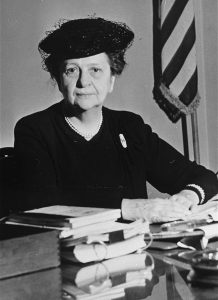
 Originally published for Women’s History Month 2025
The workers’ rights we benefit from today are grounded in the legacy of Frances Perkins.
Long before she was the first woman appointed to a presidential cabinet, Frances was born and raised in New England by a socially conservative family, spending summers in Newcastle, Maine and winters with her grandmother in Worcester, MA. Frances began studying physics at Mount Holyoke College, the oldest higher education institution for women in the country. However, a visit to local mills during an economic course introduced her to the need for labor reform. Though her family expected her to return home and work as a teacher until she was married, after graduation, Frances relocated to Illinois, volunteering at Hull House where her passion for labor reform and women’s suffrage was further fueled.
Frances would study Sociology and Economics at the Wharton School and then Columbia University, earning her a Masters Degree at a time when few women had a degree of any kind. During her time at Columbia, Frances worked at settlement houses, which allowed her to live and work alongside the low-income, largely immigrant, community.
After graduation, Frances was involved in labor organizations, such as the Consumers League and the Committee on Safety of the City of New York. She was integral in lobbying New York state legislature in limiting working hours for women and children, particularly in light of the catastrophic Triangle Shirtwaist Factory fire. She was an eyewitness to the disaster.
Frances continued to play a pivotal role in labor reform in the state of New York, including as Industrial Commissioner under then Governor Franklin D. Roosevelt. It is no surprise that when we became president in 1933, he would also appoint her as Secretary of Labor. This role came at a critical time as the country crawled out of the rubble of the stock market crash of 1929 and was deep into the Great Depression. As Secretary of Labor, Frances oversaw the development of Social Security benefits and national labor reform through the Fair Labor Standards Act which established unemployment benefits, workplace safety regulations, child labor restrictions, minimum wage, and the forty-hour work week. Due to her contributions to the development of the U.S. Employment Service and public works projects, many claim that she was the primary architect of FDR’s “New Deal.”
Backlash was inevitable, however, and she was charged with protecting communists by the House Un-American Activities Committee. Accusations grounded in homophobia, sexism, and xenophobia were rampant but ultimately the Committee could not charge her with anything. President Roosevelt did not defend Frances and prevented other cabinet members from doing so. They would have further rifts due to her pacifist stance in the wake of World War II. Nonetheless, she retained her role as Secretary of Labor for eighteen years
In 1913, Frances married Paul Caldwell Wilson, though retaining her maiden name professionally. Work came first for both Frances and Paul, which strained their relationship. However, pregnancy difficulties and the birth of their daughter Susanna in 1916 kept them together. Shortly thereafter, Paul began experiencing erratic behavior, identified as “manic depression” at the time, and required care at institutions until his death in 1952. She did not discuss these challenges publicly.
Frances began a relationship with Mary Hartman Rumsey, whom she lived with in Washington, D.C. Mary was a social leader in her own right, founding the Junior League and serving as chair of the Consumer Advisory Board. Evidence documents a close, loving relationship that was likely romantic, though short-lived as Mary passed away in 1934. She would later share a home with U.S. Representative Caroline O’Day, who was a woman who loved other women, but there are no letters, journals, or documents indicating the nature of their relationship.
Frances continued to serve during the Truman administration on the Civil Service Commission until 1952 and would lecture at Cornell University after leaving public office. She also published a bestselling biography of FDR, The Roosevelt I Knew. She enjoyed intellectual debate with students at the Telluride House, an academic living community, for many years before she passed away.
Sources
Chaiklin, Harris. “Perkins, Frances: The Roosevelt Years.” Social Welfare History Project, 2012. https://socialwelfare.library.vcu.edu/eras/great-depression/perkins-frances-the-roosevelt-years/.
“Discovering Frances Perkins.” The ILR School, February 24, 2009. https://www.ilr.cornell.edu/news/about-ilr/discovering-frances-perkins.
Dolkart, Andrew S. “Frances Perkins Residence.” NYC LGBT Historic Sites Project, July 2023. https://www.nyclgbtsites.org/site/frances-perkins-residence/.
“Her Life.” Frances Perkins Center. Accessed March 11, 2025. https://francesperkinscenter.org/learn/her-life/.
Salvo, Victor. “Frances Perkins.” Edited by Owen Keehnan. Legacy Project Chicago. Accessed March 11, 2025. https://legacyprojectchicago.org/person/frances-perkins.
Photo Credit
Frances Perkins: Secretary of Labor Frances Perkins at her desk, ca. 1938. National Archives and Records Administration, College Park, MD.

Learn About Other Queer Icons
Worcester & HIV Care | Queer Worcester Icons 2026
In the early 1980s, patients, predominantly young gay men, began arriving in hospitals with a...
Elizabeth Bishop | Queer Worcester Icons 2026
While she avoided the public spotlight, Elizabeth Bishop’s lasting legacy places her among one of...

John O’Reilly & James Tellin | Queer Worcester Icons 2026
For 60 years collage artist, John O’Reilly (1930-2021) and sculptor James “Jim” Tellin (1930 -...