
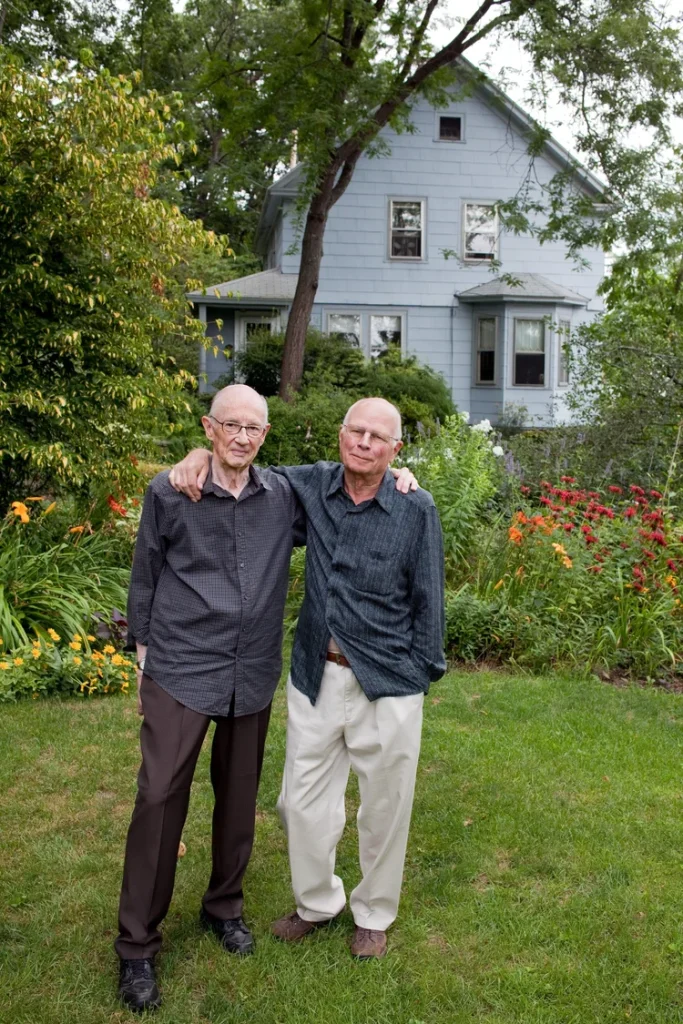
 For 60 years collage artist, John O’Reilly (1930-2021) and sculptor James “Jim” Tellin (1930 – 2023) lived in Worcester, though a small town near Malaga, Spain was their spiritual home.
John was raised in the very Catholic household of his grandfather in Red Bank, New Jersey. “We had a chapel in the house,” John recalled. “My sister and I would play, and I would pretend to be a priest.”
Committed to his art, John studied at Syracuse University and the School of the Art Institute of Chicago, where he met his life partner, James Tellin.
“When we started out, no gay couples thought of making a life together,” Jim reflected in his later years. However, John was insistent that they wouldn’t live in secret and wanted to life together in a committed relationship.
Decades before gay marriage would be legalized, in 1960, John and Jim honeymooned to Spain in 1960. They spent several months in a small town outside of Malaga, immersing themselves in the community. They lived without running water, newspaper, or paper products. The Spanish bowls in their home and commitment to life’s simplicity would survive for decades. Even though they would return to the United States, this place would always be their true home.
Shortly after returning from Spain, Jim and John settled in Worcester when their car broke down in Worcester while travelling from New York City to Bar Harbor, Maine. The stories differ about why they decided to stay: sometimes they would say they were too broke, others because they knew the city had job opportunities.
They found work splitting a full-time art therapist role at Worcester State Hospital, supporting patients experiencing mental health challenges. This arrangement allowed them steady income, while having time to dedicate to their art. At times, this work inspired themes, as O’Reilly, in particular, would often grapple with issues of reality and imagination, conscious and unconsciousness, and how faith, morality, and sanity is constructed.
Over the decades, much of John’s intricate photo collages remained private. His work would often combine self-portrait photography and modern concepts, like technology and architecture, with historical photos and artwork, creating interesting juxtapositions of subject and style. Erotic images were also frequent in his work that reflects on his identity as a gay man. This approach would evoke strong feelings from viewers, even to the point of him being escorted out of a gallery when a patron threatened him for his “anti-Catholic” work.
The assembly of these collages are as much a part of the art as the subject and source materials. Objects are meticulously cut from photos, books, and magazines and arranged seamlessly. Friend and writer describes the experience as “a vortex pulling you in.” He adds further, “O’Reilly settles his fragments in a most exacting way, to create a multileveled landscape, turbulent but absorbing.”
With the onset of the Gulf War, John’s art began to critique war and systemic violence in the 1990s, which would often elicit content warnings from galleries. The series also incorporates themes of religious oppression, likely reflecting on messaging prominent throughout the AIDS Crisis. At the age of 65, his work caught national acclaim in 1995, when his work was included in the Whitney Biennial.
Even in older age, John would find new source material for his collages, such as a whimsical series incorporating children’s coloring books that was released in the 2017 retrospective “A Studio Odyssey,” at the Worcester Art Museum. These collages reflected on his childhood, especially loneliness and anxiety as a gay child in a Catholic household.
O’Reilly explained, “Growing up where I did as a gay person, that was a sort of natural feeling as a kid. You lied. You lied all the time about it. And the pictures that I take reveal nudity and I’m kind of a gangly looking person who’s never completely happy with my look. I always wanted to be something else. And so I deliberately took pictures of myself nude. Which was kind of a trespass even against myself.”
Jim’s sculptures take a similar approach, changing meaning with perspective as you move around them. He uses basic shapes and colors in abstract arrangements to convey meaning. He had his first gallery show in 2009 at the Cantor Art Gallery at Holy Cross, displaying his wall-mounted and small nature-inspired pieces from the 1990s.
John and Jim’s Worcester homes were central to their art and community. While they seldom collaborated on works, they would exchange ideas and critique. Their home was filled with artwork, rare books, plants, and novelties to inspire them, as well as host other creatives. In fact, over the decades, several photographers have documented their home, studio, and art collection, capturing its significance as a center of artistic practice and queer domesticity. Many of these collections, as well as some of John’s War Series, are held at The Morgan Library and Museum. Other collections are archived at the Addison Gallery of American Art at Phillips Andover Academy.
Sources
1980 Photo Series by Paul A. McDonough: https://addison.andover.edu/search-the-collection/?embark_query=/artist-maker/info/3370?artistName=Paul%20A.%20McDonough
1168 Grafton Street: https://worcester.emuseum.com/objects/54935/1168-grafton-street
John O’Reilly and Jim Tellin, Documentary by Stephen DiRado: https://www.youtube.com/watch?v=RM_IXQWinI8
2017 Interview with John O’Reilly and Jim Tellin for A Studio Odyssey with Worcester Art Museum: https://www.facebook.com/watch/?v=335032378142550
Photo Credit
Rubin, Seth David. John and Jim in Worcester, MA, 2012 from the 1168 Grafton Portfolio at the Worcester Art Museum

Learn About Other Queer Icons
Worcester & HIV Care | Queer Worcester Icons 2026
In the early 1980s, patients, predominantly young gay men, began arriving in hospitals with a...
Frances Perkins | Queer Worcester Icons 2026
Originally published for Women’s History Month 2025 The workers’ rights we benefit from today are...
Elizabeth Bishop | Queer Worcester Icons 2026
While she avoided the public spotlight, Elizabeth Bishop’s lasting legacy places her among one of...