
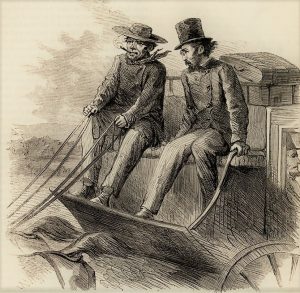
 “One-Eyed” Charley Parkhurst (1812 – 1879) caught national acclaim as a skillful stagecoach driver.
Charley’s upbringing is murky. He was born around 1812 in New England – records conflict between New Hampshire and Worcester. “He told one of his associates that came from New Hampshire, but he did not tell the name of the town,” an 1880 article explains. “He told others that he came from the poor-house in Worcester, from which he had run away.”
However, the most well-documented assumption is that Charley was born in Lebanon, New Hampshire to Ebenezer and Mary (Morehouse) Parkhurst. When Mary died in 1813, Charley and his sister were placed in an orphanage, a common occurrence for families who could not afford to raise large families.
By the 1830s, records are clearer. Charley found work at Ebenezer’s Balch’s stables in Worcester and later relocated with him to Providence. Soon, Charley was driving stagecoach roots between Providence, Boston, Worcester, and New York, managing up to six horses on his rides. He was one of the most skillful drivers in the region, frequently requested by wealthy customers.
“His judgment as to what could and what could not be done with a waggon [sic] was always sound,” an article recalled, “and his pleasant manners won him friends every where.”
He picked up the nickname “One Eyed Charley” around this time, after a horse kicked him, leaving him blind in his left eye and partially disfigured. Officially, the Providence City Directory listed them as “Charles D. Parkhurst.”
Like many young people at the time, Charley was caught by the California Gold Rush. In search of a better life, in 1851, he headed West to San Francisco to work with James Birch, a prominent businessman who had livery businesses throughout Northern California.
Charley’s skill with horses became all the more renowned as he mastered travel throughout the rugged terrain throughout the mining region. Driving a coach was more than just working with horses. Coach drivers transported guests of all statuses, delivered mail, and were frequently held up by bandits. Charley was able to balance this all. His skill earned him a salary of $125 a month, when most sailors and miners made $20-$35.
Myth continued to take hold around “One Eyed Charley,” also known as “Six Horse Charley,” including his bravery in fighting off robbers single-handedly. However, all accounts have a common thread of Charley’s tobacco chewing habit and love of cards and dice, just as frequently as they discuss his friendly, generous, and responsible nature.
As railroads became the preferred way of travel and sciatica began to impede Charley, he retired in the 1860s. He operated a stagecoach stop “Sand Hill Station” and a saloon. Later, she bought a ranch near Watsonville, California with Frank Woodward. They raised with chicken and cattle and operated a woodcutting business. In 1868, Charley Parhurst registered to vote.
Finally, in 1873, Charley sold his businesses. After years of hard work, he settled into a cabin. As arthritis began to riddle his body and a consistent sore throat plagues him, a twelve-year-old neighbor, George Harmon, looked after him. Charley died on December 28, 1879 at the age of 67 from tongue and mouth cancer.
As funeral preparations began, the coroner discovered that Charley was female. However, some posthumous accounts state that people know Charley was assigned female at birth or many suspected he may have been intersex because of his small build and high-pitched voice.
Presumably, as a child, Charlotte Parkhurst recognized the difference in how boys and girls were treated. He decided to runaway – either from his uncle’s home or an orphanage – and live as a boy. While this is a simple 19th Century explanation, Charley’s consistent and persistent male identity leads one to believe that he was likely transmasculine, in modern understanding of gender. Further, given the safety concerns of being discovered during his life and the secrecy he maintained – unlike notable cross-dressing women like Deborah Sampson – it is likely that Charley identified as male.
After his death and the discovery of his gender assigned at birth, more myths took shape. For example, Charley is often cited as the first woman to vote in the United States, despite the fact that other women voted due to varied state laws, and Charley likely identified as a man, plus may not have even voted after registering. These accounts would take all shapes of sensationalizing Charley’s story, some celebrating the achievements of a woman while others scrutinizing his motivations. Many children’s stories claim Charley as a female icon of the Wild West, which simultaneously uplifts an important story while diminishing his likely queerness.
Charley was buried in the Watsonville Odd Fellows Cemetery, also known as the Pioneer Cemetery. Assumed to be lost, decades after his death, the Pajaro Valley Historical Association found his grave in 1954 and instilled a permanent granite marker.
Sources
Frey, Holly, and WIlson, hosts. Charley Parkhurst, One-Eyed Whip. Stuff You Missed in History Class. iHeart, July 31, 2013. 22 min. https://www.iheart.com/podcast/105-stuff-you-missed-in-histor-21124503/episode/charley-parkhurst-one-eyed-whip-30208087.
Maryborough Chronicle, Wide Bay and Burnett Advertiser (Queensland). “The Female Stage-Driver.” May 15, 1880. Trove.
Southwick, Albert B. “The Life of One-Eyed Charley.” The Worcester Telegram & Gazette, September 25, 2014. https://www.telegram.com/story/news/local/worcester/2014/09/25/the-life-one-eyed-charley/36343097007/.
Young, PhD., Elaine. “Charlotte Darkey Parkhurst.” Washington County Historical Society. Accessed August 11, 2026. https://wchsutah.org/people/charlotte-darkey-parkhurst.php.
Photo Credit
Illustration of Charley Parkhurst driving the journalist J. Ross Browne in Placerville, California, from the May 1865 issue of Harper’s New Monthly Magazine.
A Note on Language
Our understanding of gender identity and sexual orientation has evolved over time. Some of the words we use today, like lesbian, transgender, or nonbinary, were not popular – or even existed – in certain periods of history.
Historians and researchers have different perspectives about how to explain sexual orientation and gender identity of people in history and what language is used. In my work, I have adopted the following guidelines, which is in no way definitive.
Sexual Orientation
I have elected to use the term “sapphic” to describe people who were perceived as women throughout the majority of their lives and had emotional and/or physical romantic relationships with other people who identified as women throughout a majority of their lives. This includes people who we may today understand as nonbinary or transmasculine, but identified or were perceived as women in their time.
Similarly, the term “achilean” is used to describe people who were perceived as men throughout the majority of their lives and had emotional and/or physical romantic relationships with other people who identified as men.
The term “bisexual” is used to describe people who had romantic and physical relationships with people of all genders throughout their lives. While today many people employ “bisxeual” as an identity, I use it as a way to describe behavior and experience in the past. For many, their sapphic or achilean experiences and sexual fluidity may not have been a central part of their identity due to societal and cultural norms of the time.
Gender Identity
Regarding people who may have been nonbinary or transgender in the contemporary understanding of gender identity, I use the word “gender non-confirming.” This includes people who were known to “cross dress” by wearing clothing considered appropriate for a gender other than that which they were assigned at birth. In some cases, these individuals were doing this to express their nonbinary or transgender gender identity, but may not always have been the case.
I have elected to use the adjectives “transmasculine” and “transfeminine” to describe the experience of someone who has considerable primary source evidence that someone lived as or felt they were a gender different from that which they were assigned at birth. Because the term “transgender” and the concept of transitioning in all aspects of life is modern, I have elected not to use that term.
In some contemporary settings, transgender women would use colloquial, non-academic/medical terms like “Queen,” to describe themselves. These terms are used interchangeably with comtemporary accepted terms in those respective profiles.

Learn About Other Queer Icons
Worcester & HIV Care | Queer Worcester Icons 2026
In the early 1980s, patients, predominantly young gay men, began arriving in hospitals with a...
Frances Perkins | Queer Worcester Icons 2026
Originally published for Women’s History Month 2025 The workers’ rights we benefit from today are...
Elizabeth Bishop | Queer Worcester Icons 2026
While she avoided the public spotlight, Elizabeth Bishop’s lasting legacy places her among one of...