
Queer people have existed in every era, in every culture, including among people who were enslaved in America.
However, there are scarce accounts and recognition of queer people who were enslaved.
Uncovering any first-hand accounts from people who were enslaved is challenging. From 1621 to 1865, it was uncommon – and even illegal – for enslaved people to read and write. In some places, it was even illegal, making it unsafe for those who could to keep records. Even if folx kept journals, diaries, or other personal accounts, they may not have kept them long-term as they were relocated, sold, or self-liberated. Those records that survived or were left behind would have needed to be deemed important enough to preserve and archive, which was unlikely given enslaved people’s social position to begin with.
Uncovering any facts about ancestors who were enslaved is often traumatic, as modern genealogists and historians must rely on public sources predominantly written by white enslavers, including financial transactions, property and tax records, auction advertisements and accounts, bounties for those attempting self-liberation, journals, and letters.
All of these research challenges are compounded with those of any queer people. Personal documents may have been destroyed, or never created to begin with, because of stigma and safety. We frequently uncover leads about queer people from this period from court and criminal records with little, if any, first-hand or unbiased information available.
As Juneteenth falls within Pride Month, today I am uplifting two stories of queer people who were enslaved, living under enormously dehumanizing, racist, misogynistic, and homo/transphobic systems that attempted to erase them: Frances Thompson and William Dorsey Swann.
Frances Thompson (c. 1840 – 1876)
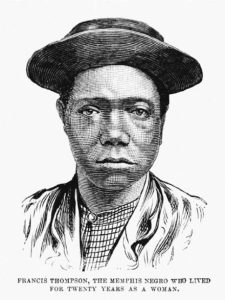
Frances was born into slavery in Maryland and moved to Memphis, Tennessee by her enslaver as a child. Though assigned male at birth, she expressed desire to live as a girl, which was supported by her enslavers. From a young age, she used a cane due to cancer in her foot that caused her legs to grow crooked.
After enslavers had been killed by the Union Army, the now-liberated Frances headed to Memphis and she rented a home on Gayso Street. Frances and her housemate Lucy Smith found work sewing, washing, and ironing clothes.
In May 1866, white police officers harassed a group of Black people, including children and Union Army veterans, who were having a party. Many revelers refused to disperse and arrests were attempted, escalating into three days of violence, including rape and arson, by white mobs. During “The Memphis Massacre,” at least 45 Black people were killed, in addition to nearly 300 more victimized, and arson destroyed 4 Black churches, four Black schools, and 91 homes and businesses.
Frances was one of the survivors of the Massacre. She was invited to testify to Congress against the white aggressors who had raped her, making her likely the first transgender woman to do so.
The Memphis Massacre would be critical in passing legislation to protect newly emancipated Black Americans, though no one would be arrested for their actions. Specifically, her and Lucy’s testimonies were used as examples of the racially-charged hatred the Black community was facing after Emancipation and made important legal strides for Black people of all genders by passing the “Reconstruction Acts.”
After the trial, Frances continued to work as a seamstress and washerwoman, as well as practiced Hoodoo. She took in a new roommate, Sallie Jordan, who was chronically ill.
As a Black transgender woman in the Reconstruction Era, she experienced similar prejudices as those who would come after her. She was arrested on several occasions for fighting, disorderly conduct, and operating a brothel, a common charge used against single Black women. In 1876, she was arrested for “crossdressing,” which was used as an example to discredit the emergent Black civil rights movement.
Frances was imprisoned among men, forced to wear masculine clothing, and sentenced to one hundred days on the chain gang. The police shared her photograph with other cities to prevent her from living as a woman in other communities. The police and newspapers made a mockery of her and crowds would flock to the chain gang’s route to harass her.
While she was serving her sentence, Frances’ landlord claimed that she was behind on rent. He petitioned the court to seize her property and auction her belongings.
She would contract dysentery shortly after her release and die within a few months.
Frances left an important legacy in her testimony of The Memphis Massacre, which would contribute to how the Reconstruction Era sought to protect newly emancipated Black people. She also stands as an example of the Black trans experience during the Civil War Era. Two other Black trans women, Anne “French Mag Porter” Casey and Jenny Smith, were arrested for crossdressing in Memphis as well. Though disregarded as copycats by the newspapers at the time, they more accurately depict the reality that the Black trans community has always existed.
Sources
Davis, Justin A. “They Charged Frances Thompson with Indecency When All She Wanted to Do Was Live a Safe Life.” MLK50: Justice Through Journalism, May 30, 2024. https://mlk50.com/2024/05/30/they-charged-frances-thompson-with-indecency-when-all-she-wanted-to-do-was-live-a-safe-life/.
William Dorsey Swann (c. 1858 – 1925)
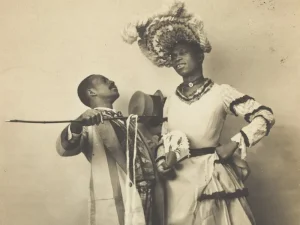
William Swann Dorsey is considered the first “drag queen.”
While men have long been dressing in women’s clothing for entertainment, notably when female actresses we banned from the theater in Elizabethan Era-England, William was the first to use the term “drag queen.”
William Henry Younker was born into slavery in Washington County, Maryland around 1858, only a few years before President Abraham Lincoln would sign the Emancipation Proclamation, legally ending slavery in the United States.
William was the fifth of thirteen children in the household of Mary Jane Younker and Andrew Jackson “Jack” Swann, an enslaved couple. Upon emancipation at the end of the Civil War, Mary Jane and Jack started their own farm in Hancock, Maryland.
When he was old enough to work, William found work as a hotel waiter. In 1880, he moved to Washington, D.C., becoming a janitor and sending money back to his family. His employers described him as “industrious,” “refined,” and “courteous,” with a “sensitive nature.”
Coming of age in the post-Civil War Era, William would have been living in a world that was as exciting as it was dangerous for a young black man.
“There were lots of things that seemed possible that had not seemed possible during the slavery era,” shares historian Channing Joseph. “I think that there was a level of excitement and possibility that drove Swann and his group to consider how they could express themselves and flout the norms of their society.”
Upon meeting other queen Black men in Washington, D.C., Willian began hosting drag balls, a term likely derived from “grand rag,” an outdated term for a masquerade ball. Surviving documents describe Black men wearing long fashionable dresses and magnificent accessories. Though there is no evidence of when William’s drag balls began, they were a regular occurrence as of 1882 and happened at least annually. While D.C. society remained segregated throughout this period, including among gay men seeking casual sex, drag balls were one of the few mixed-race events.
Drag balls grew out of cake-walks. To make a mockery of their former masters, Black people would don over-the-top, gaudy costumes and perform dances that mimicked the attitudes of pompous white people around them. Sometimes, enslavers would watch these dances, no the wiser that they were being mocked, and award the most entertaining performers with a cake.
In the decades following the Civil War, Black communities in D.C. would hold Emancipation Day parades and crown a “queen of freedom.” William was likely inspired by this tradition and began crowning winners of the drag balls he hosted, as well as receiving the nickname “The Queen.” Thus, the “queen of the drag” became the first documented person to call themselves such.
Though there were no laws against cross-dressing in Washington, D.C., formally enslaved black people held their drag balls in secret. In fact, when the police broke up one of William’s balls in 1896, he was charged with running a brothel, as there was no other relevant charge.
There are several articles documenting drag balls, largely reporting on police raids and resistance from patrons, as little positive journalism existed or survived from the Black community, especially those who did not conform. These events echo the experience of the Stonewall Riots which would occur eight decades later.
William was continuously arrested for hosting drag balls. In 1896, he was denied a pardon from President Grover Clevland and sentenced to 300 days in prison.
By 1900, William left Washington, D.C., likely finding it difficult to find stable work due to his increasing notoriety. He passed away in 1925. For no stated reason, town officials burned his house upon his death, destroying all of William’s personal items.
Though William’s story ended, his legacy continued through drag balls in Washington D.C. in beyond. His young brother, Daniel J. Swann was a well-known tailor in the drag community until his own death in 1954.
The story of the first drag queen was uncovered in 2005 by then-journalism student, Channing Joseph, who discovered an 1888 Washington Post article entitled, “Negro Dive Raided. Thirteen Black Men Dressed as Women Surprised at Supper and Arrested.”
Sources
Joseph, Channing Gerard. Swann, William Dorsey. 2021. https://doi.org/https://doi-org.libproxy1.usc.edu/10.1093/acref/9780195301731.013.79001.
Ore, Jonathan. “America’s First Drag Queen Was a Former Slave and LGBT Rights Crusader, Says Historian.” CBC Radio, February 28, 2020. https://www.cbc.ca/radio/day6/teck-frontier-mine-medical-assistance-in-dying-1990s-mls-wilson-cruz-the-first-drag-queen-and-more-1.5477892/america-s-first-drag-queen-was-a-former-slave-and-lgbt-rights-crusader-says-historian-1.5478181.
Shane, Cari. “The First Self-Proclaimed Drag Queen Was a Formerly Enslaved Man.” Smithsonian Magazine, Smithsonian Magazine, June 9, 2023. https://www.smithsonianmag.com/history/the-first-self-proclaimed-drag-queen-was-a-formerly-enslaved-man-180982311/.
Photo Credit
There are no known photos of William Swann Dorsey. This period photo of a Black person in feminine drag demonstrates how William may have dressed and symbolizes that drag in the Black community was ubiquitous beyond William and his community.
Two black actors perform a cake-walk in Paris, circa 1903. By the turn of the 20th century the cake-walk had grown in popularity overseas, particularly in France. (James Gardiner Collection/Submitted by Channing Joseph)

Learn About Other Queer Icons
Worcester & HIV Care | Queer Worcester Icons 2026
In the early 1980s, patients, predominantly young gay men, began arriving in hospitals with a...
Frances Perkins | Queer Worcester Icons 2026
Originally published for Women’s History Month 2025 The workers’ rights we benefit from today are...
Elizabeth Bishop | Queer Worcester Icons 2026
While she avoided the public spotlight, Elizabeth Bishop’s lasting legacy places her among one of...