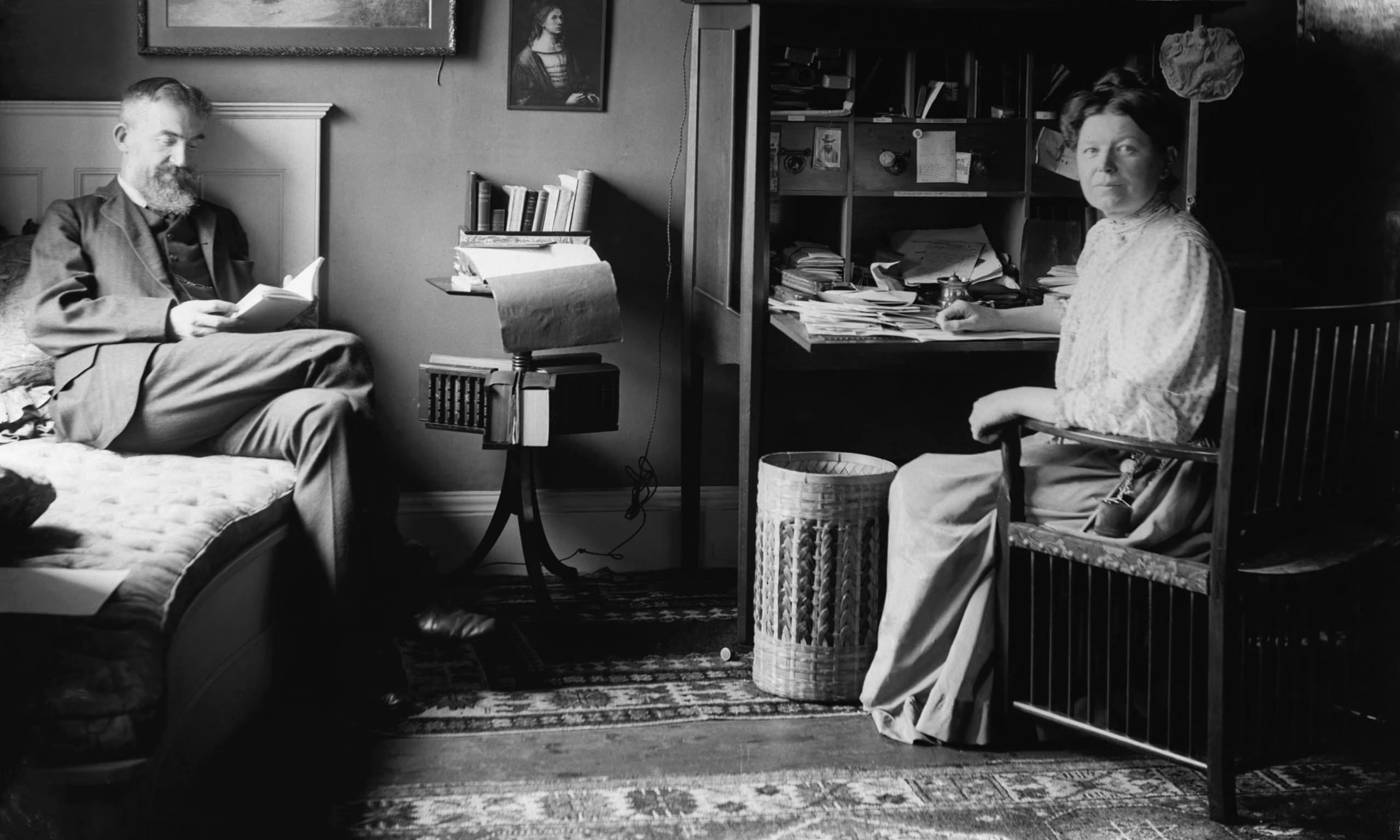
George Bernard Shaw and his wife, Charlotte, at their home in London, circa 1905. (Photo by Hulton Deutsch/Corbis/Getty Images)
It is important that researcher have an expansive view of asexuality as a fluid identity, which is true of all queer identities, that may change over a person’s lifetime and manifest differently for each individual.
Embracing Nuance and Fluidity
It is important that researcher have an expansive view of asexuality as a fluid identity, which is true of all queer identities, that may change over a person’s lifetime and manifest differently for each individual.
“We will be hard- pressed to find asexuality in many places,” asexual scholars Ela Przybylo and Danielle Cooper explain, “especially historically speaking, if we are bound to its contemporary definitions as a more or less stable, inherent, biologically determined absence of sexual interest. If, on the other hand, we imagine asexuality expansively, we can work toward seeing asexuality everywhere, assembling dynamic asexual historiographies and archives.”
Charlotte Payne-Townshend and George Bernard Shaw (G.B.S.) married in 1898. While the Irish playwright is known for his satirical works that transformed theater, Charlotte was also a champion of progressive thought. Though she had a wealthy upbringing, she was a leading champion of socialism and women’s rights in Britain. The couple agreed to seldom, if ever, consummate their marriage.
“As man and wife,” G.B.S. wrote, “we found a new relation in which sex had no part.” Biographers have used Charlotte’s politics as an explanation or disinterest in having children, rather than interrogating any further. Very little of her personal writing survives. However, a 1963 biography provides a more in-depth sketch. The biographer discusses Charlotte’s several suitors before marriage, all of whom she had strong relationships with, but ended in a declined proposal. While Charlotte sometimes used disparate wealth or feminism as an excuse, there are also glimpses of her feeling unable to requite romance in the same way, similar to how we discuss asexuality and aromanticism today. G.B.S. did report that Charlotte did not like physical contact.
As a playwright, there are more firsthand accounts from G.B.S. including interviews, letters, and the themes of his plays. His plays often praise female characters who are intellectual and independent, but also devoid of sex. Some works even go as far as to demonize the concept of sex, though most are simply indifferent towards the subject.
However, these were more than literary tropes. In his collection of autobiographical essays Sixteen Self Sketches, G.B.S. reflects on his sexuality as interest in flirting with women, but indifference to actually acting on those feelings. In fact, he explains that, as he matured, he was put off when women were interested in taking flirtations to another level. “Unfortunately,” he wrote, “I had no sooner lost my illusions, my timidity, and my boyish curiosity about women, than I began to attract them irresistibly. My amusement at this soon changed to dismay.”
Despite being married, having romantic suitors, and, in the case of G.B.S., potentially lovers with physical connection, they each demonstrated varying levels of disinterest, indifference, and despising of sex that ebbed and flowed throughout their lives. While some biographers use Freudian methods to explain G.B.S. or discount Charlotte’s identity as an extension of her radical feminism, a more expansive analysis considers that they may have fallen under the asexual umbrella. Their individual experiences and nature of their marriage support the need for a definition of asexuality that appreciates fluidity over time, rather than essentialism.
Asexuality & Politics
Sex and power are intimately tied.
Throughout history there are examples of how sex has been negotiated in politics, forging alliances, dictating religion, and transforming society.
Because of this, refusal of sex has also been used as a political tool, which is often misclassified as asexuality. For example, in the 1960s, feminist leaders Dana Densmore and Valerie Solanas advocated for abstinence as a tool for sexual liberation and bodily autonomy. Their philosophy was to usurp the importance of sex and recalibrate expressions of love and partnerships. While this aligns with some principles of asexuality, the reality is that many of the participants chose celibacy and still were otherwise interested in sex, which is not congruent with the asexual experience.
Queen Elizabeth I of England is a noted example of this. Known as the “Virgin Queen,” she never married or had children. While she did have “favorites,” men who she shared intimate relationships with, it is unclear whether these were platonic or romantic, physical or celibate. Historians believe her decision not to marry or have children was political, particularly given the volatile politics of father King Henry VIII, his eight wives, and several children, both legitimate and not. Because of her role as one of the world’s longest-ruling monarchs, gender-defying role as an unpartnered female ruler, and both of her parents’ reputations, Elizabeth I’s sexuality and gender have been interrogated for centuries.
Most current research suggests that Queen Elizabeth I never married and was likely celibate for political reasons, much like Dana Densmore and Valerie Solanas. However, it does open up the opportunity to analyze her archives, both her personal writings and writing from people who knew her, with an asexual lens to see if new insights might be gained.
Suggested Reading
Elizabeth Hanna Hanson, “Making Something Out of Nothing: Asexuality and Narrative” dissertation, 2013, Loyola University Chicago
Yujia Zhu, “Invisible Desires: Uncovering Asexual Histories and the Erasure of Non-Sexual Identities in Historical Narratives,” 2025, Proceedings of The World Conference on Social Sciences
Michael Waters, “Finding Asexuality in the Archives,” 2020, Slate
Bibliography
Did you miss Part 1: Demystifying Asexuality?
Did that example spark some ideas for your museum or organization?
Let’s connect to make those ideas a reality! Book a Discovery Call today.